
Curry County Sex Offender Checks
The New Mexico Department of Public Safety Law Enforcement Records Bureau operates the New Mexico DPS Sex Offender Registry through OffenderWatch. Curry County Sheriff personnel register and update people subject to New Mexico law, while NMDPS publishes the information the law allows. That split matters. The sheriff is the local registration and verification point, but the state interface is the main public search layer.
Start with a name when the identity is known. Use a geographic search for neighborhood awareness, then read the complete public result instead of relying on a map point. Registration duties can arise from New Mexico convictions and from out-of-state, tribal, federal, military, or foreign convictions that NMDPS translates to a New Mexico equivalent. A no-result screen does not prove that no registration duty exists because some registered groups are expressly non-releasable.
Registry path: Curry County Sheriff registration › NMDPS review and public release › OffenderWatch search and email alerts.
Curry County Registry Listing Limits
New Mexico draws a line between the duty to register and public release. Some people report every ninety days or twice a year yet remain in a non-releasable classification. Others appear publicly when their offense and the governing law permit release. The public Curry County sex offender results are therefore a legally filtered view, not a complete roll of everyone known to registration staff.
If a person expected in the search is missing, first check spelling and place details. Next, try the national layer for a move across state lines. Suspected noncompliance belongs with the Curry County Sheriff or the NMDPS Sex Offender Registry unit, not with social media. Registration staff can examine status and jurisdiction facts that a public screen cannot resolve.
Note: Public absence can reflect a non-releasable classification, a jurisdiction change, or search input, so it is not proof of no duty.
New Mexico DPS Sex Offender Registry Searches
OffenderWatch supports verified high-level name and geographic searches as well as neighborhood email alerts. Anti-automation protection prevented reliable inspection of every control, radius choice, and format. For that reason, the table below stays at the level established by NMDPS research and does not claim that a particular box, dropdown, or distance setting is always present.
- Open the NMDPS-linked OffenderWatch entry and read the conditions governing public registry use.
- Choose a name search or the available geographic search and enter only the details the live interface requests.
- Review the result list, place information, and status labels without treating a similar name as a confirmed identity.
- Open the public profile, note the source jurisdiction and compliance language, then verify concerns with the sheriff or NMDPS.
| Verified Search Area | Control Type | Required | Research Limit |
|---|---|---|---|
| Name | Text search | Depends on search mode | Exact split between first and last name should be checked live |
| Geographic area | Place or address search | Depends on search mode | Address, city, ZIP, and radius controls were not fully verified |
| Neighborhood alerts | Email signup | Only for alerts | Follow the current interface prompts for area and contact details |
Curry County Offender Cross-State Search
The National Sex Offender Public Website adds a cross-state public search when a person may have moved, works across jurisdictions, or has an offense from another system. It does not replace New Mexico's registry. NSOPW draws from participating jurisdiction public records, while the Curry County search remains tied to New Mexico's public-release rules and local sheriff updates.
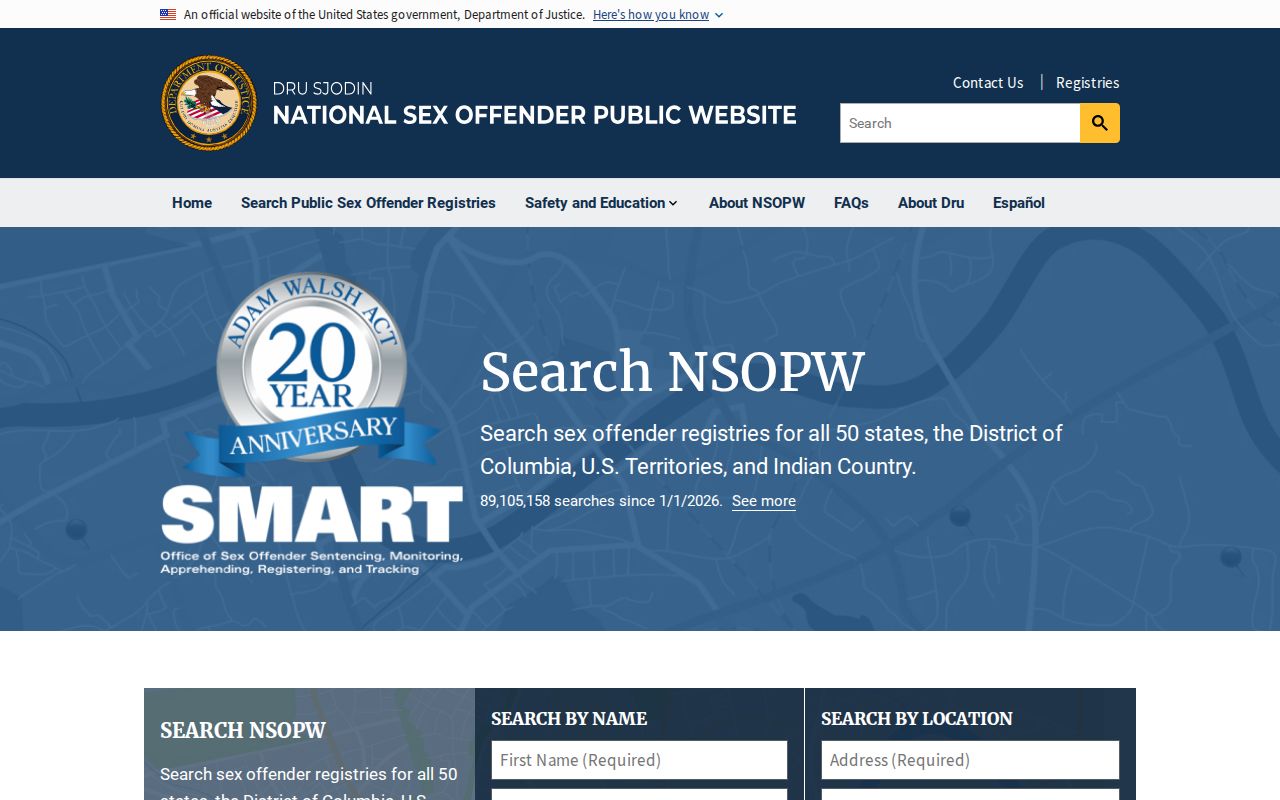
The national interface is most useful as a second layer. A public match still needs careful review of the reporting jurisdiction, offense data, and current registration status before anyone draws a conclusion.
Cross-state convictions receive another New Mexico step. NMDPS compares an out-of-state, tribal, federal, military, or foreign offense with New Mexico law to decide the equivalent registration duty. That review can explain why the label or frequency seen here differs from terminology used by the convicting jurisdiction.
Registry Profiles: What They Show
A public profile may contain the fields below when the governing law and the live record permit release. NMDPS access protection prevented a non-identifying sample inspection, so none of these items should be read as a promise that every Curry County registry profile displays every field. The sound approach is to treat the live profile labels as controlling and leave blanks or omissions unexplained until an agency confirms them.
| Name and Aliases | Possible identifying names associated with the public registration record |
|---|---|
| Photo and Description | May include a photograph and physical traits such as height, weight, hair, and eyes |
| Address Information | May show legally releasable residence information at the detail allowed by law |
| Offense Information | May include offense description, statute, jurisdiction, and conviction date |
| Status | May identify registration or compliance information reported to the system |
| Other Descriptors | May include vehicles or scars, marks, and tattoos when released on the live profile |
Read status alongside the offense and jurisdiction. A photo or map point is not a full account of the legal record, and an old image does not establish a person's current appearance. The registry is an awareness tool based on released registration data, not a court docket or a fingerprint-supported criminal history.
Curry County Registry Email Alerts
OffenderWatch offers neighborhood email alerts. This is the practical route for someone who wants notice when the public system reports a relevant change near an area, rather than repeating the same Curry County offender search by hand. Use the live signup controls because the research did not verify exact radius choices or every address field.
An alert reflects information released through the registry. It does not replace a direct report about suspected noncompliance, and it should not be used to organize contact with a registrant or household. Send a specific concern to the Curry County Sheriff or email dps.sorna@dps.nm.gov. The NMDPS Registry Unit also lists 505-476-2444 for registry matters.
Registration Levels and Duties in New Mexico
New Mexico's published classifications describe how often a person reports and whether information may be released. They are not the federal Tier I, Tier II, and Tier III labels. Sections 29-11A-1 and following set the registration and public-release structure, while Section 29-11A-4 makes the length offense-specific. A duty generally runs for ten years or life, but the classification name alone does not select the duration.
| NMDPS Classification | Reporting Frequency | Public Visibility | Duration |
|---|---|---|---|
| 90 Day Re-Registrants | Quarterly | Released when law permits | Ten years or life, based on offense |
| 90 Day Non-Releasable | Quarterly | Not public | Ten years or life, based on offense |
| Annual Registrants | Annual | Public when permitted | Ten years or life, based on offense |
| Annual Non-Releasable | Annual | Not public | Ten years or life, based on offense |
| Semi-Annual Non-Releasable | Twice yearly | Not public | Ten years or life, based on offense |
Weekly reminder mailings help support compliance, but the county sheriff remains the local registration point. There is no statewide New Mexico rule that bars every registrant from living within one fixed distance of a school, park, or similar place. Separate supervision conditions can still restrict a particular residence.
Curry County Registration Classification Review
Equivalency can be hard when the conviction came from another state or legal system. NMDPS has a rule for contesting how an offense was translated into a New Mexico equivalent. The issue is classification, not a public vote on whether someone should register. Questions should move through the official process with the conviction and jurisdiction details intact.
The NMDPS equivalency-contest rule sets that administrative path. It can matter when a public label, reporting frequency, or release result seems inconsistent with the source conviction. The Curry County Sheriff updates local registration facts, while NMDPS handles the state-level equivalency and public system.
Note: A disagreement with an equivalency decision belongs in the NMDPS process, not in a public confrontation or an informal online campaign.
Curry County Registry and Expungement
New Mexico maintains civil forms for expungement, but elapsed time does not make every record eligible. Sex offenses are among the excluded categories identified in the researched expungement framework. Registry duties and public court-record access also arise under different laws, so a change in one system should never be assumed to erase a duty in another.
The New Mexico Judiciary publishes its civil and expungement form index for the official filing paths.
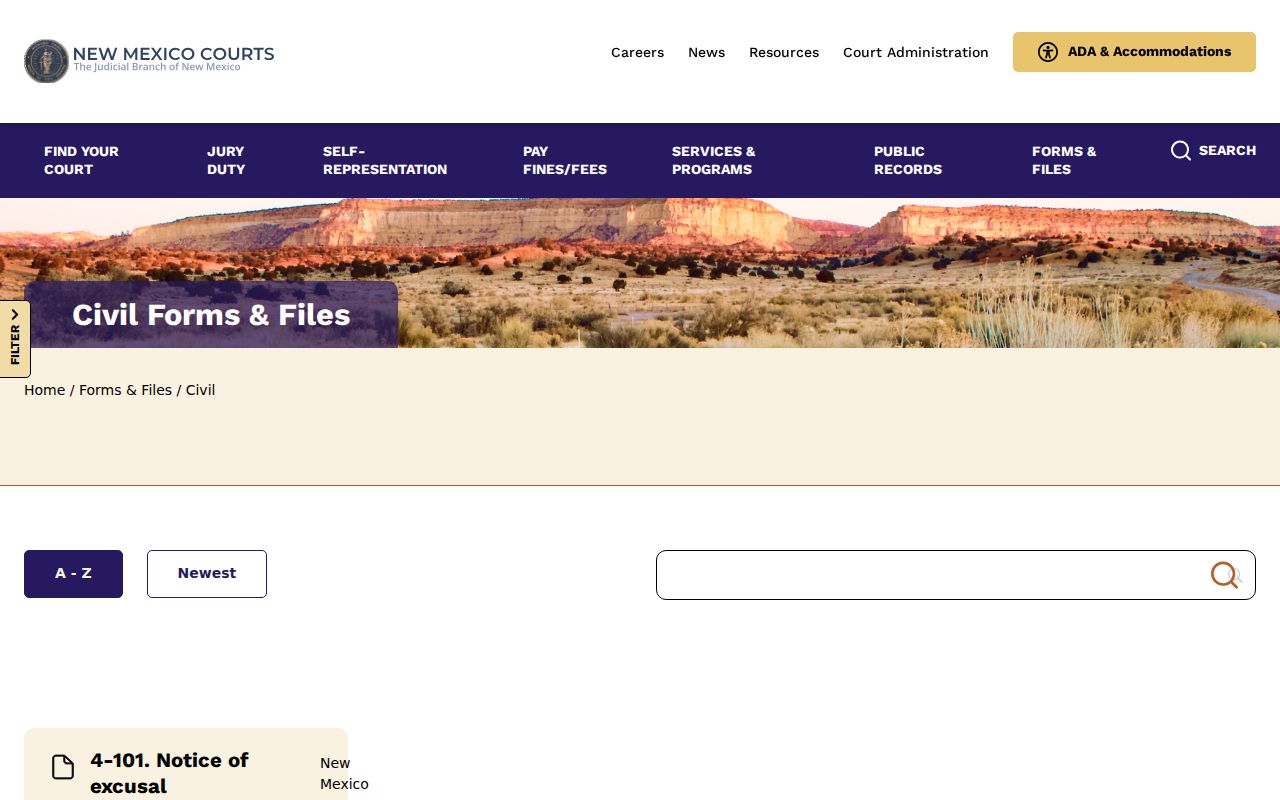
The form index shows why court relief requires a case-specific process. A registry question should go to the sheriff or NMDPS, while a Curry County court-record question belongs with the Ninth Judicial District Court.
Using Registry Information Lawfully
Public registry data supports personal safety planning and community awareness. It does not authorize threats, retaliation, intimidation, or unwanted contact. Use the official email-alert system for notice, report a concrete compliance concern to the proper agency, and let law enforcement determine whether the facts amount to a violation.
Sections 29-11A-1 and following of the New Mexico Sex Offender Registration and Notification Act govern the registration and public-release structure researched for Curry County. Those rules define what may be released. They do not grant private enforcement power to a search user.
Misuse is a crime: Do not use New Mexico DPS Sex Offender Registry information to harass, threaten, intimidate, or retaliate against a registrant or household. Such misuse may be prosecuted under New Mexico law; Sections 29-11A-1 et seq. govern the researched registry disclosure system.